
Should an Orlando roofing company invest in social media? Yes — but not the way most contractors do it. Random photo posts a few times a month do almost nothing. What actually wins storm jobs in Central Florida is a consistent feed built around short-form video — Reels and TikToks of drone flyovers, tear-offs, and hail damage — because that is the format the algorithms push to homeowners who don’t follow you yet, and it’s where a growing share of people vet a contractor before they call.
Orlando sits in one of the most storm-battered roofing markets in the country. When a Central Florida hail cell or a hurricane band moves through, thousands of homeowners pull out their phones at the same time — checking your reviews, scrolling your Facebook, and deciding in seconds whether you look like a real, trustworthy operator. This guide breaks down why organic social (led by Reels) is now table stakes for Orlando roofers, what the current data says, and how to run it without hiring a full content team. It’s written for the roofing owner who’d rather be on the roof than editing video — and for the GHL agency serving roofing clients across Florida.
Key Takeaways
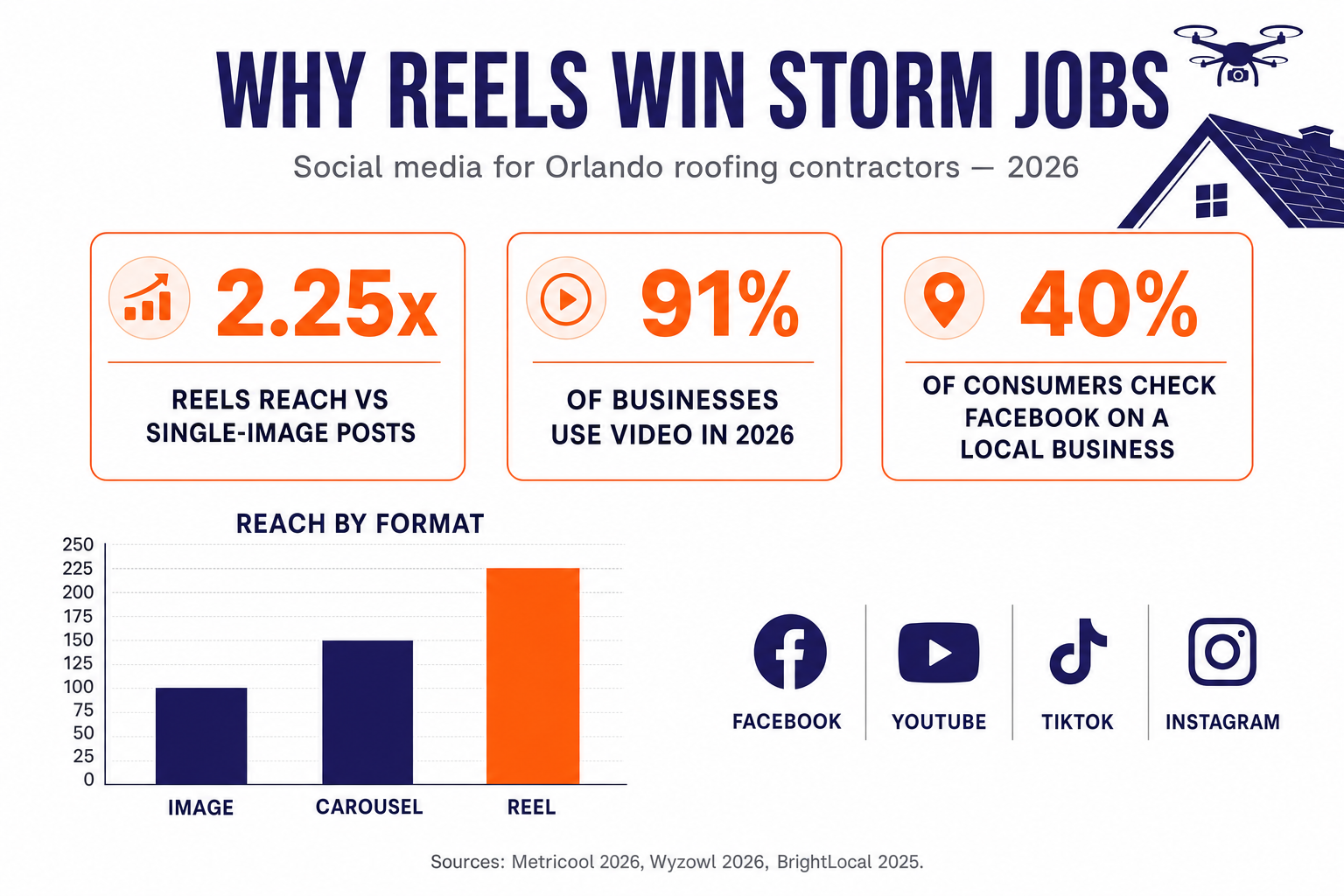
- Instagram Reels reach ~2.25× more people than single-image posts (Buffer analysis of 4M+ posts, via Metricool’s 2026 Instagram Study) — Reels are how you get in front of Orlando homeowners who don’t follow you yet.
- 91% of businesses use video as a marketing tool in 2026, and 82% of marketers say video delivers good ROI (Wyzowl State of Video Marketing 2026) — short-form is now the highest-ROI format.
- 40% of consumers check Facebook, 34% YouTube, and 20% TikTok when researching local businesses (BrightLocal Local Consumer Review Survey 2025) — your social feed is part of the buying decision, not an afterthought.
- The U.S. had 27 separate billion-dollar weather disasters in 2024 (~$182.7B), including 5 tropical cyclones (NOAA / Climate.gov) — Florida is ground zero, and every storm sends a wave of homeowners to their phones.
- The problem isn’t whether social works — it’s consistency. Posting 5 days a week across every channel is a second job, which is exactly why done-for-you social media for roofers exists.
Table of contents
- The short answer for Orlando roofers
- Why storm season makes social non-negotiable in Central Florida
- Why Reels beat everything else right now
- Where Orlando homeowners actually check you
- What to actually post: the roofing content that works
- The real problem: consistency, not creativity
- How social plugs into your lead pipeline
- FAQ
The short answer for Orlando roofers
Social media works for Orlando roofing companies when it does two jobs at once: discovery (getting your work in front of new local homeowners through short-form video) and trust (giving a storm-panicked homeowner a reason to believe you’re real when they check you out). Reels and TikToks handle discovery because the algorithms actively push them to non-followers; your existing feed, reviews, and Google Business Profile handle trust.
The mistake almost every roofer makes is treating social like a bulletin board — a job photo here, a “we’re hiring” post there, weeks of silence in between. That pattern gets almost no reach because the algorithm has nothing fresh to distribute and no signal that you’re active. The roofers winning storm jobs on social are posting consistently and leaning heavily on video.
Why storm season makes social non-negotiable in Central Florida
Central Florida roofing demand is driven by weather, and the weather has been relentless. The U.S. logged 27 separate billion-dollar weather and climate disasters in 2024, totaling roughly $182.7 billion in damage — including five tropical cyclones (NOAA / Climate.gov). The 2024 Atlantic hurricane season alone produced 18 named storms, 11 hurricanes, and 5 major hurricanes (NOAA), and Hurricanes Helene and Milton drove more than $100 billion in combined damage across Florida and neighboring states in a two-week stretch (NOAA / Climate.gov).
Here’s what that means on the ground in Orlando: every one of those events triggers a synchronized wave of homeowners doing the exact same thing — grabbing their phone and researching roofers. Some search Google. But a large and growing share also scroll Facebook groups, tap through Instagram, and watch a couple of TikToks to figure out who looks legit. If your feed is a ghost town when that wave hits, you’re invisible in the moment demand peaks.
Why Reels beat everything else right now
If you only change one thing about your roofing social media, make it this: post short-form video, consistently. The data is lopsided.
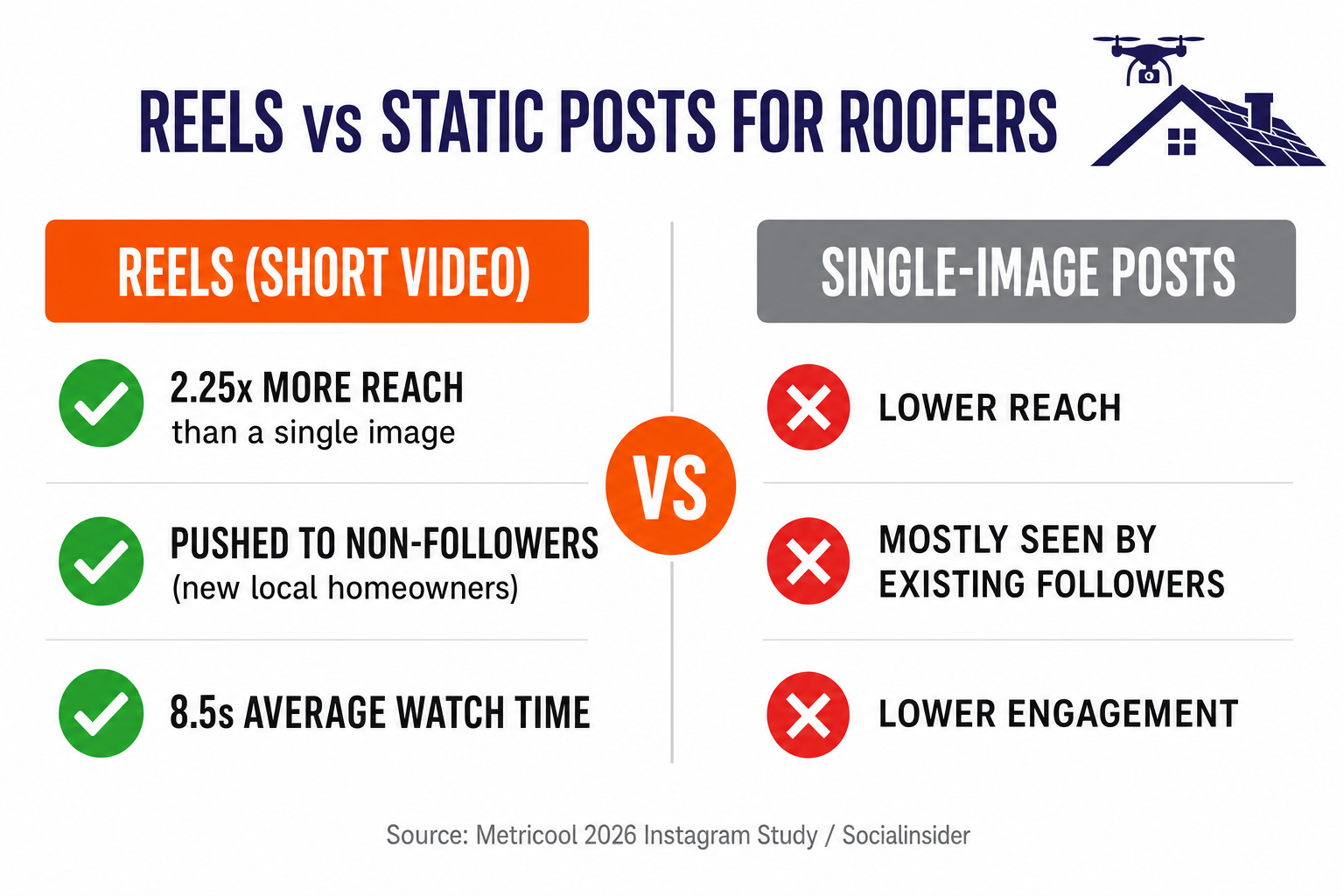
Reach. Instagram Reels reach roughly 2.25× more people than single-image posts (based on Buffer’s analysis of more than 4 million posts, cited in Metricool’s 2026 Instagram Study). Reach is the whole game for a local roofer — it’s how you get in front of homeowners who’ve never heard of you but live three streets over from the roof you just replaced.
Engagement. Across Socialinsider’s benchmarks, Reels average about a 0.52% engagement rate and carousels about 0.55% — both far ahead of the static single image (Metricool 2026 Instagram Study). Average Reel watch time also more than doubled year over year to about 8.5 seconds, a signal the algorithm reads as “keep showing this.”
Buyer preference. Video isn’t a fad you can wait out. 91% of businesses use video as a marketing tool in 2026, and 82% of video marketers report a good ROI, with short-form cemented as the highest-ROI format (Wyzowl State of Video Marketing 2026). Wyzowl also finds a majority of consumers would rather watch a short video to understand a product or service than read about it.
Relative reach on Instagram by post format (single image = 1.0×). Reels reach 2.25× a single image and about 1.36× a carousel. Source: Buffer / Metricool 2026 Instagram Study.
The practical takeaway for an Orlando roofer: a single 20-second drone flyover of a completed reroof, captioned and posted as a Reel, will out-reach ten static “finished another job today” photos combined. And because Orlando is a dense, weather-active market, that reach lands on exactly the homeowners most likely to need you next.
Where Orlando homeowners actually check you
When a homeowner is deciding whether to trust a roofer, they don’t stop at Google — they cross-check you across several platforms. BrightLocal’s 2025 survey of U.S. consumers found that when researching local businesses, people use Google (83%), local news sites (48%), Yelp (44%), Facebook (40%), YouTube (34%), and TikTok (20%) (BrightLocal Local Consumer Review Survey 2025).
That spread is the whole argument for a multi-channel presence. If a homeowner finds you on Google but your Facebook was last updated 14 months ago and your TikTok doesn’t exist, you’ve introduced doubt at the exact moment you needed to remove it.
Share of consumers who use each platform when researching a local business. Source: BrightLocal Local Consumer Review Survey 2025.
This is also why social and reviews reinforce each other. A homeowner who sees an active feed and a wall of recent 5-star reviews converts far more easily than one who sees either alone — which is why we pair social with a system that harvests more Google reviews and local SEO for roofing contractors. Your social feed proves you’re active; your reviews prove you’re good.
What to actually post: the roofing content that works
You don’t need a studio. The best-performing roofing content is stuff you can already capture on a jobsite with a phone and a cheap drone. The trick is packaging it as short-form video and posting it on a rhythm.
- Drone flyovers of completed roofs. A slow, clean orbit of a finished reroof is the single most credible piece of content a roofer can make. Caption it with the neighborhood (“New architectural shingle roof in Winter Park”).
- Tear-off and time-lapse clips. Satisfying, fast, and algorithm-friendly. A 15-second tear-off time-lapse reliably out-performs a static “before/after” image.
- Hail and storm-damage explainers. Short clips walking a homeowner through what hail bruising looks like or how a claim actually works. This is trust-building content that also captures storm-season search intent.
- Q&A / myth-busting. “Do you handle the insurance paperwork?” “How long does a reroof take?” Answer real homeowner questions on camera — these double as FAQ content your AI chatbot can reuse.
- Crew and behind-the-scenes. Real people build trust. A 10-second clip of your crew loading a truck at dawn humanizes the brand.
The real problem: consistency, not creativity
Here’s the honest truth most agencies won’t tell you: the reason roofing social media fails is almost never a lack of ideas. It’s that posting consistently across every channel is a second full-time job, and nobody running crews and closing deductibles has those hours.
Think about what “doing it right” actually requires: shooting and editing video, writing platform-specific captions, cropping each asset to the right size for Facebook, Instagram, TikTok, YouTube, and more, scheduling it 5 days a week, and then replying to every comment and DM before the lead goes cold. Doing that in-house means hiring a designer, a video editor, a social manager, and a community manager — a combination that typically runs $4,000–$8,000 a month.
That math is why done-for-you social exists at a fraction of the cost. The Roofing Snapshot social media package publishes for you 5 days a week across 9 channels (Facebook, Instagram, Google Business Profile, LinkedIn, TikTok, YouTube, Pinterest, Threads, and Bluesky) — every week you get 1 text post, 1 image post, 2 carousels, and 1 short video/Reel, all written in your company’s voice and roofing-specific. Three AI agents handle the follow-through: one replies to comments, one answers Facebook and Instagram DMs and books inspections, and one runs web chat. It starts at $397/mo for one brand ($997/mo for up to 4 brands), with no setup fee and white-label by default.
How social plugs into your lead pipeline
Reach is worthless if the lead falls through the cracks. The point of a strong Orlando social presence isn’t vanity metrics — it’s feeding your pipeline. That means every comment and DM needs to be captured and answered fast, because speed-to-lead decides who signs the roof. A homeowner who DMs “do you do metal roofs?” at 9 p.m. and gets an answer in 30 seconds is a booked inspection; the same DM ignored until morning is a competitor’s job.
That’s why we wire social directly into the CRM: Instagram DM automation and Facebook Messenger automation capture the conversation, qualify the homeowner, and drop them onto your calendar; the AI chatbot does the same on your website; and review harvesting turns every closed job into the social proof that makes the next homeowner convert. Social gets you seen — the automation makes sure being seen turns into signed roofs.
If you’d rather hand the whole thing off, that’s what the social media package and a dedicated GHL VA are for. And if you want the full storm-to-deposit system behind it, that’s the Roofing Snapshot.
Frequently asked questions
Social media marketing for Orlando roofing contractors — FAQ
Is social media marketing worth it for a roofing company in Orlando?
Yes, when it's done consistently and led by short-form video. Central Florida's storm-driven demand sends waves of homeowners to their phones to vet roofers, and BrightLocal's 2025 survey found 40% check Facebook, 34% YouTube, and 20% TikTok when researching local businesses. A dormant feed makes you look inactive at the exact moment demand peaks. The catch is consistency — random monthly posts get almost no reach.
Why are Reels and short-form video better than regular photo posts?
Reels reach roughly 2.25× more people than single-image posts (Buffer analysis via Metricool's 2026 Instagram Study) because the algorithm actively pushes them to people who don't follow you yet — which is exactly the local discovery a roofer needs. Static photos are mostly seen only by your existing followers. Video is also now the dominant format: 91% of businesses use it in 2026 and 82% of marketers report good ROI (Wyzowl).
How often should an Orlando roofer post on social media?
Aim for something every business day — around 5 posts a week — with a mix of formats and at least one short video/Reel weekly. Consistency matters more than volume: the algorithm rewards active accounts and punishes silence. Most roofers can't sustain that in-house, which is why done-for-you services post 5 days a week across all 9 channels for you.
What should a roofing company actually post?
Content you already capture on the job: drone flyovers of finished roofs, tear-off time-lapses, hail-damage and insurance-claim explainers, on-camera answers to common homeowner questions, and short crew/behind-the-scenes clips. Capture daily, then repurpose one job's footage into a Reel, a carousel, a YouTube Short, and a Facebook post.
How much does done-for-you roofing social media cost?
Building it in-house (designer, video editor, social manager, community manager) typically runs $4,000–$8,000/mo. The Roofing Snapshot social media package starts at $397/mo for one brand — 1 text, 1 image, 2 carousels, and 1 Reel per week published across 9 channels, plus AI agents for comments, DMs, and web chat — or $997/mo for up to 4 brands, white-label with no setup fee.
How long until social media brings in roofing leads?
Organic growth compounds, so expect meaningful reach and inbound in roughly 3–5 months as the algorithms start surfacing your content to new local audiences. Because you're posting consistently across many channels, a single Reel can go viral and bring leads much sooner — but anyone promising overnight results isn't being honest.
Related posts
- How to Get More Google Reviews for Your Roofing Company
- Facebook Ads for Roofing Contractors
- Local SEO for Roofing Contractors
- Why a 30-Second Response Wins Storm Jobs
- AI for Roofing Contractors
Written by Marcus Ellison, GHL Agency Partner & Growth Advisor (Tampa, FL). Marcus runs a small GoHighLevel agency on the Gulf Coast that productizes roofing snapshots for contractors across hurricane country — reviews that compound, Google profiles that rank, and social feeds that turn storm-season attention into booked inspections. He writes for both the agency owner reselling GHL and the roofer who just wants the phone to ring.