
The hail came through your town on a Thursday afternoon. By Saturday morning there are three trucks you have never seen parked on the good street in your service area, the one with the big roofs and the paid-off houses. The guys knocking doors have out-of-state plates and matching polos. By the time you drive out there Monday to look at your own leads, four homeowners already have a signed contract taped to their fridge. You have been roofing in that town for twelve years. You coach the youth league. And a crew that will be gone by December just took the four best jobs on the block.
Here is the short version, and it stings a little. The out-of-state storm chaser did not beat you because he is a better roofer. He beat you because he was faster. He had a system for getting to the door inside 48 hours while you were finishing last week’s jobs and letting storm leads pile up in a voicemail box. Speed is the whole game after a storm, and it is the one thing you can fix. This post breaks down where you lose the race, stage by stage, with the messages you can steal and the point where each stage breaks.
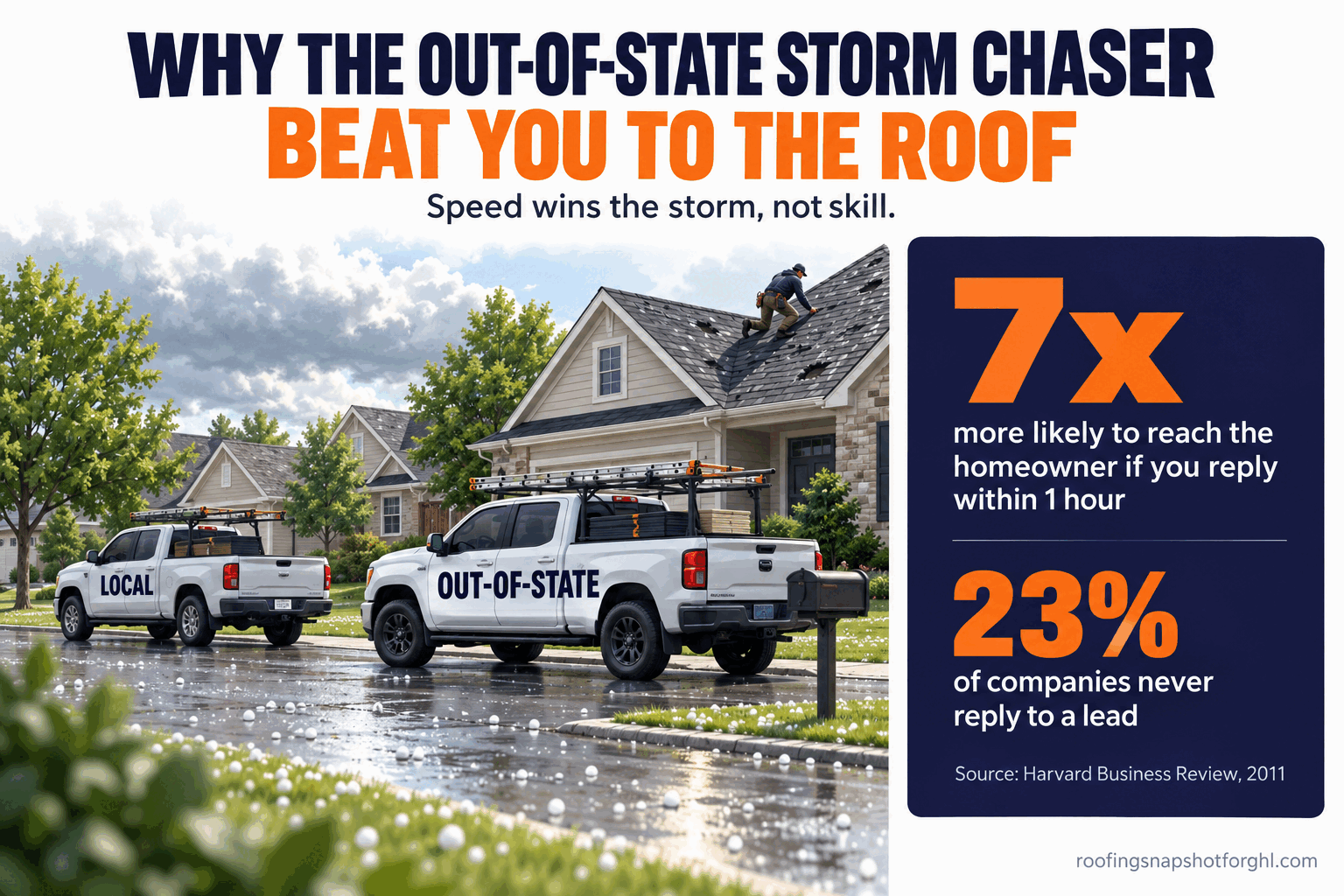
Table of contents
- What losing the neighborhood actually costs you
- Why the out-of-state crew gets there first
- The race to the roof, stage by stage
- Steal this: the storm-response message pack
- You vs the chaser, side by side
- Which version fits your shop? Three scenarios
- The legal line you cannot cross
- Objections, answered honestly
- FAQ
What losing the neighborhood actually costs you
Run the math on that Thursday storm. Four roofs on the good street, call it an average storm job at $12,000 to $15,000 each. That is near $55,000 in revenue that drove out of town with a crew that will never pull a permit in your county again. You did not lose it to a better bid. You lost it to a knock that happened two days before yours.
Now layer in what you spent to have a shot at those homes. The average roofing lead runs $228.15, the most expensive category LocaliQ tracks across home services, against an all-trades average of $90.92 (LocaliQ, 2025). Your ads, your yard signs, your Facebook boost, all of it exists to make the phone ring after a storm. When a lead sits for 48 hours, you paid full price and gave the job away for free.
The deeper cost is the street itself. A block re-roofed by an out-of-state crew is one you are locked out of for 15 to 20 years. No referral jobs, no “my neighbor used you” calls, no reviews from those homeowners. And when the chaser’s work fails in year three and he is nowhere to be found, that bad taste spreads to every roofer, including you. Losing the storm is not one bad weekend. It is a hole in your pipeline that lasts a decade.
Why the out-of-state crew gets there first
The traveling crew is not magic. It runs on one idea: be first to the door while the damage is fresh and the homeowner is rattled. Severe weather is lumpy, which is what makes speed decisive. NOAA logged 5,432 major hail events in the US in 2025, up from 5,373 in 2024, and they cluster hard by state. Texas alone had 902 hail events of one inch or larger in 2025, Kansas had 375 (Insurance Information Institute / NOAA SPC). A market gets a handful of big event weeks and a long quiet stretch. Whoever owns those few weeks owns the year.
The chaser also knows a number you probably do not track: how slow the average contractor is. The Harvard Business Review study “The Short Life of Online Sales Leads” sent a web lead to 2,241 US companies and timed the replies. Only 37% responded within an hour, 24% took more than a day, and 23% never responded at all. Among those that did reply, the average response took 42 hours (Harvard Business Review, 2011). That slow average is the gap the chaser drives his truck through.
How fast 2,241 US companies responded to a web-generated sales lead. Nearly half took more than a day or never answered. Source: Harvard Business Review, “The Short Life of Online Sales Leads,” 2011.
Here is the part that should change how you run storm season. Speed is the single biggest lever on whether you ever talk to the homeowner. Companies that made first contact within an hour were nearly 7 times more likely to qualify the lead, meaning actually reach the decision maker, than companies that waited one more hour. Against companies that waited 24 hours or more, the gap was over 60 times (Harvard Business Review). An older study of more than 15,000 leads found the odds of even contacting a lead were 100 times higher at 5 minutes than at 30 minutes (InsideSales / Dr. James Oldroyd). The chaser treats the first hour like gold. Most local shops treat it like paperwork for later.
The race to the roof, stage by stage
Think of storm season as a six-stage race. The chaser is good at the first three and terrible at the last three. That is your opening. Win the speed stages and your local advantages, the warranty, the reputation, the fact that you still exist next year, close the deal for you.
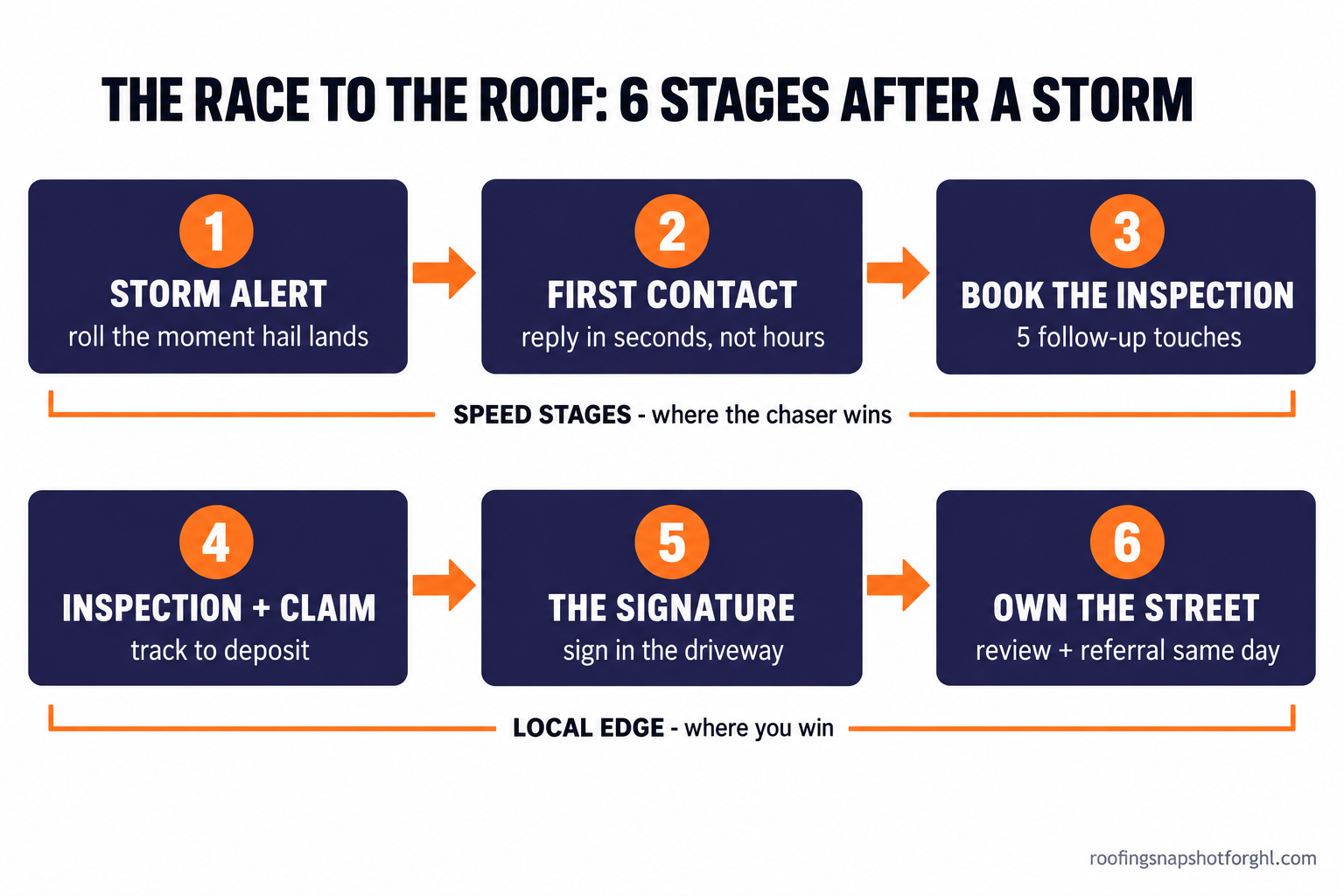
Stage 1: The alert. The chaser watches radar and insurance filings and rolls trucks toward fresh hail the same day. You find out a storm mattered when leads trickle in over the next week. Close that gap with a storm trigger: a severe-weather alert on your core ZIP codes so the moment hail lands, you are canvassing and running ads into that exact area, not reacting a week late. How it breaks: owners set the alert and then ignore it because they are buried on current jobs. It has to route to someone whose only job that week is new business, or it is noise.
Stage 2: First contact. This is where the race is won or lost. A storm lead that comes in by web form, missed call, or Facebook message needs a human-sounding reply in seconds, not hours. If your answer is “we’ll call you back when the guys are off the roof,” you already lost to the crew that texted back in 40 seconds. Build an instant auto-response that fires the moment a lead lands, then a live call fast behind it. This one change does more than any ad you will ever run, as we broke down in why a 30-second response wins storm jobs. How it breaks: the auto-text goes out but nobody calls behind it, so the lead gets a robot and then silence. Automation starts the conversation. A person still closes it.
Stage 3: Booking the inspection. Most leads do not book on the first touch. The chaser knocks again in person. You knock again digitally. A booked inspection needs a short, friendly follow-up sequence over the first few days, not one voicemail and a shrug. If you are still handing paper door-hangers to a canvasser and hoping the notes come back, you are losing leads in the truck. Track every door and every lead in one pipeline, the way we lay out in turning door-knocking into a tracked pipeline. How it breaks: the follow-up stops after one try. The money is in touches two through five, which almost nobody sends by hand.
Stage 4: The inspection and the claim. Now your local edge kicks in. You can meet the adjuster, you know the local code, and you will be here for the warranty. The chaser is already eyeing the next town. Make this stage organized: confirm the appointment, send a reminder so the homeowner is actually home, and track the claim from inspection to deposit so nothing stalls. A missed inspection is a lead you paid for, showed up for, and still lost. We cover cutting those no-shows in how to reduce roofing inspection no-shows. How it breaks: the claim goes quiet for two weeks while you are busy, the homeowner gets nervous, and the chaser’s “we handle everything” pitch suddenly sounds good again.
Stage 5: The signature. The homeowner is deciding between the local roofer and the out-of-state truck. The chaser closes with urgency and a too-good deductible promise. You close with trust, a real contract, and financing if they need it so a $14,000 number does not send them back to the cheaper pitch. Have the agreement ready to sign on the spot, digitally, because the homeowner who sleeps on it is the one the next knocker gets. How it breaks: you leave to “write it up at the office” and lose the moment. The paperwork has to be ready while you are in the driveway.
Stage 6: Owning the street. This is the stage the chaser cannot touch, and it is how this storm feeds the next three years. The day the tear-off finishes, ask for a review while the roof is fresh and the homeowner is thrilled, then ask who else on the block took damage. One happy roof turns into three if you ask at the right moment. A traveling crew never asks because they are already two states away. We dig into the timing in getting more Google reviews for roofing. How it breaks: the review ask happens two weeks later by email, when the excitement is gone, and you get crickets.
Steal this: the storm-response message pack
Copy these, change the name and the brackets, and load them into your follow-up tool. This is the exact cadence that beats a door knock. Keep the tone human. A storm lead can smell a corporate robot.
That last line does two jobs. It gets the review and it opens the referral on the same block, while the chaser is already gone. If you want to mine old storm leads that went cold the same way, the approach in database reactivation for roofing contractors uses the exact same bones.
You vs the chaser, side by side
The chaser wins the first few hours. You win everything after the handshake. The trick is to stop losing on speed so your real advantages get to matter.
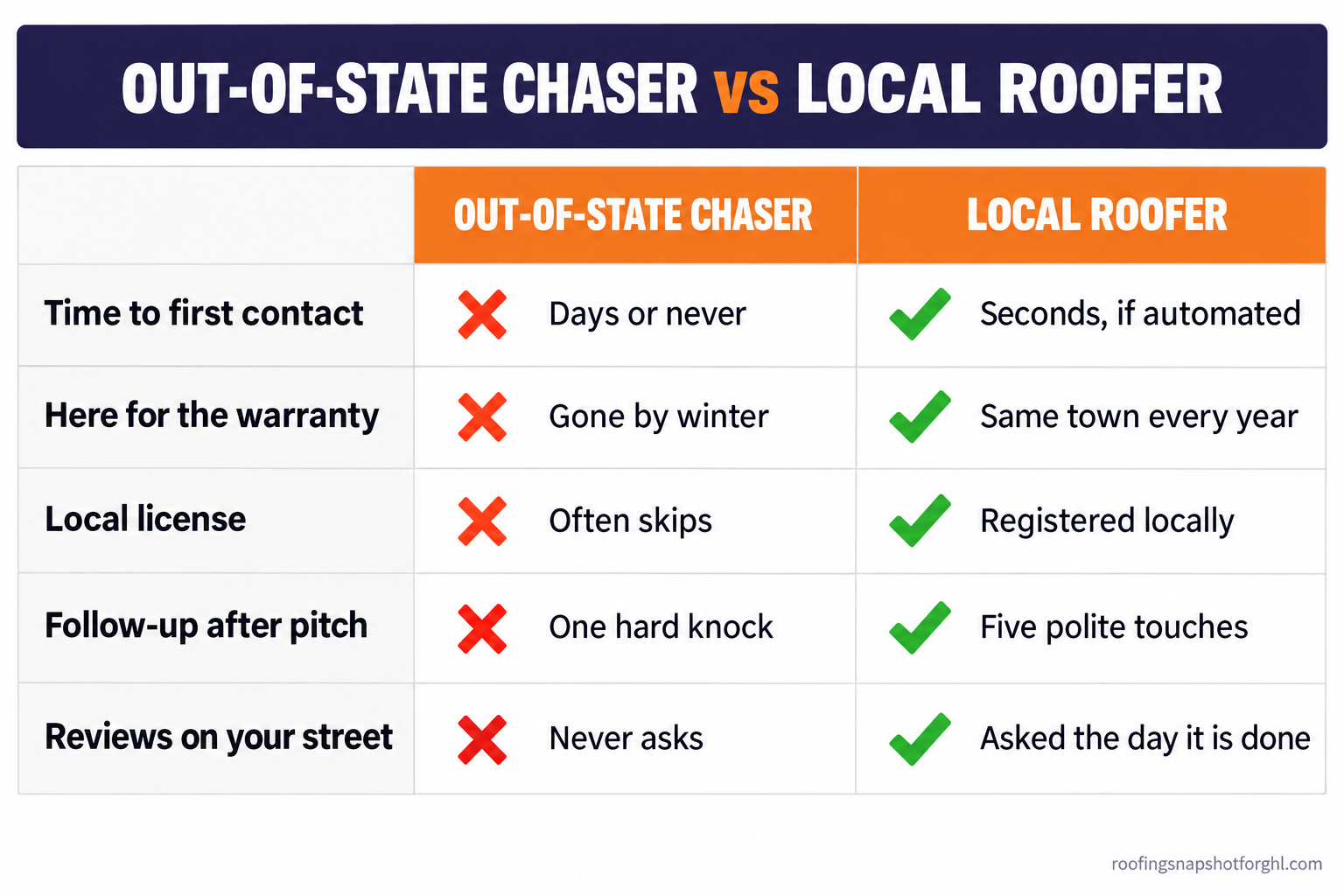
| What the homeowner weighs | Out-of-state storm chaser | The local roofer who shows up first |
|---|---|---|
| Time to first contact | Minutes, in person at the door | Seconds, if you automate it. Days, if you do not |
| Here for the warranty | Gone by winter, different state | Same town, same number, every year |
| Local license and registration | Often skips local registration | Registered and known to the county |
| Follow-up after the pitch | One hard knock, then nothing | Automated, polite, five touches |
| Reviews on this street | None, they never ask | Asked for the day the roof is done |
| Accountability if it leaks | No forwarding address | You, in person, next Tuesday |
The only column where the chaser beats a well-run local shop is that first row. Fix the first row and the whole table tilts your way.
Which version fits your shop? Three scenarios
The same six-stage system scales down to a solo operator and up to a multi-crew outfit. What changes is how much runs on autopilot versus a person.
The solo operator or two-man shop. You are on the roof all day, which is exactly why you lose the speed race. You cannot answer a lead at 2pm from a ladder. For you, automation is the only way to be fast while your hands are full. Set the instant auto-text and the three-touch sequence to run without you, forward the live call to your cell or a cheap answering service for the first ring, and batch your callbacks for lunch and end of day. You will never out-knock a crew of ten, but you can out-respond them, because software does not climb down a ladder to reply.
The 2 to 3 crew shop. Your problem is not capacity, it is that storm leads compete with your current jobs for attention and lose. Assign one person (office manager, a part-time VA, your spouse) to own new leads during a storm week and nothing else. Give them the pipeline, the alerts, and the message pack above. One dedicated responder plus automation clears a storm’s worth of leads without pulling a crew off a roof. A GoHighLevel VA is a cheap way to staff this.
The larger storm-restoration outfit. You already canvass. Your leak is coordination: door-knockers, inbound leads, and adjuster schedules living in three places. Put every door and every lead in one pipeline so a canvasser’s knock and a web form for the same house do not get worked twice or dropped. Route storm alerts to the canvassing lead, auto-assign inbound leads by ZIP, and dashboard which streets are hot in real time. At your size, the win is never dropping a lead across a chaotic 300-door week.
The legal line you cannot cross
Speed is the goal, but two rules will cost you far more than a lost roof if you break them. The chaser breaking them is not your permission to.
First, the texting rules. Automated SMS to a US lead falls under the TCPA and A2P 10DLC carrier registration. You need real consent before you text, your messages must identify you and offer a clear opt-out, and your number has to be registered or the carriers filter you into oblivion. This is not red tape you skip because you are in a hurry. We walk through it in A2P 10DLC registration for roofing contractors, and the FCC lays out the basics in its TCPA rules.
Second, the claims line. In several states it is flatly illegal for a contractor to negotiate an insurance claim for the homeowner or to offer to absorb, waive, or rebate their deductible. That is the chaser’s favorite pitch and the exact copy that gets a local roofer fined. Do not promise to “handle the claim” or “cover your deductible” anywhere. Help the homeowner document damage, meet the adjuster, and do quality work, and let them deal with their insurer. We cover the state-by-state picture in roofing insurance claim laws. The Better Business Bureau has warned homeowners for years about out-of-state crews leaning on deductible promises and pressure tactics (BBB storm-chaser warning). Being the roofer who does it straight is a selling point. Use it.
Objections, answered honestly
“I can’t text a lead back in seconds, I’m on a roof all day.” Right, and that is the point. You personally cannot. Software can. The instant auto-text and the follow-up sequence run without you touching your phone. The only live part is a callback you can batch twice a day. You are not promising to answer at 2pm. You are promising the lead hears something useful at 2pm so they do not call the next truck.
“Won’t homeowners find the automated texts annoying?” Not if they sound like a person and they are relevant. A lead who just reported storm damage wants to hear back fast. The annoying version is the generic blast with no name and no opt-out. The pack above uses their name, references their town, and gives them an easy out. Done right, fast follow-up reads as “this roofer is on it,” which is exactly the impression that beats the chaser.
“The chaser is cheaper, I can’t compete on price.” You are not competing on price, you are competing on risk. The chaser is cheaper because he will not be here when the flashing fails. Say that out loud to the homeowner. Your warranty means something because you still exist next year. Price matters less than you think once a homeowner pictures calling a disconnected number in year three.
“I already pay for a CRM. Isn’t this the same thing?” Maybe, if your current CRM actually fires an instant response and runs multi-touch follow-up on autopilot. Most roofing CRMs are built to store jobs, not to win the first hour. The question is not “do I have software,” it is “does a storm lead hear back in 60 seconds without anyone lifting a finger.” If the honest answer is no, the tool is not doing the one job that beats the chaser.
FAQ
Out-of-state storm chasers and winning the neighborhood: FAQ
Why do out-of-state roofers always get to the storm first?
They treat speed as the business model. They track radar and insurance activity, roll crews toward fresh hail the same day, and knock while the damage is top of mind. They are not better roofers, they are first. The fix is to be fast too, which for a local shop means automating the first response so a lead hears back in seconds while your crews are on a roof. Companies that make contact within an hour are nearly 7 times more likely to reach the decision maker (Harvard Business Review).
Is it legal for out-of-state contractors to work roofs in my state after a storm?
It depends on the state. Some have no roofing license at all, while others require registration and, in disaster areas, a specific emergency registration. Many traveling crews skip local registration, which is one reason the BBB warns homeowners to verify licensing and check for a local business presence before signing (BBB). Check your own state licensing board for the current rule.
How fast do I actually have to respond to beat a storm chaser?
Minutes, not hours. The odds of reaching a lead are about 100 times higher at 5 minutes than at 30 minutes (InsideSales / Dr. James Oldroyd), and the odds of qualifying it are nearly 7 times higher within the first hour than an hour later (Harvard Business Review). Since 23% of companies never respond at all, being fast and consistent puts you ahead of most of the field.
Can I legally text storm leads back automatically?
Yes, if you follow the rules. US business texting falls under the TCPA and A2P 10DLC carrier registration. You need prior consent, every message must identify you and offer an opt-out, and your number must be registered to send business messages. Skip registration and carriers will filter your texts. See our guide to A2P 10DLC registration for roofing contractors and the FCC's TCPA rules.
What should I never say to a homeowner after a storm?
Never promise to handle their insurance claim or to cover, waive, or rebate their deductible. In several states that is illegal for a contractor, and it is the exact pitch that gets local roofers fined. Help them document damage and meet the adjuster, but let them deal with their insurer. Details in roofing insurance claim laws.
Back to that Thursday storm and the three strange trucks on the good street. The chaser did not have a better crew or a better price. He had a 40-second reply while you had a full voicemail box. Fix the first hour, load the message pack, and ask for the review the day the roof is done. Next time hail rolls through, you are the one knocking before the out-of-state plates even find the neighborhood. You live here. Act like it, fast.