
The contract got signed on a Tuesday. Firm handshake, deposit collected, the homeowner is thrilled. Then nothing. Materials are on order, the permit is somewhere in a county office, and your crew is finishing two other roofs before they get to this one. You know all of that. The homeowner knows none of it. By the following Monday they have texted twice with no reply, they are telling their spouse they think they got scammed, and the five-star review you earned by closing the deal is quietly turning into a one-star about “no communication.” The roof is going to be perfect. The customer is already unhappy. Nobody did anything wrong except go silent.
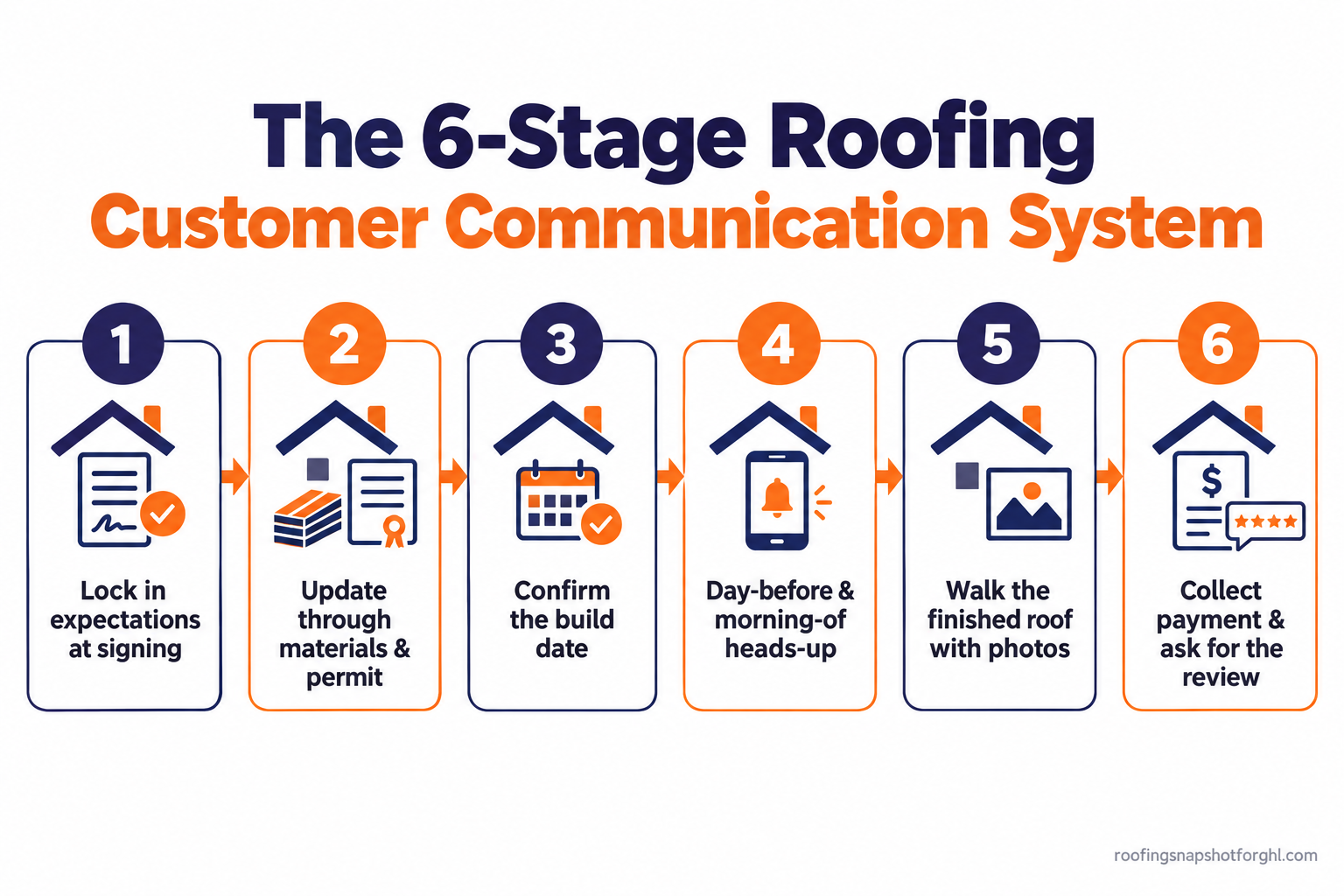
Here is the short answer. You fix this with a post-sale communication system that keeps the homeowner in the loop from the minute they sign to the minute they pay, automatically, so you are never the reason a good job turns into a bad review. It is six stages: lock in expectations at signing, update them while materials and the permit move, confirm the build date, warn them the day before and the morning of, walk the finished roof with photos, then collect payment and ask for the review while they are still glowing. This is that system, stage by stage, with the exact texts you can steal and the way each one breaks when you wing it instead.
Key Takeaways
- Silence is the problem, not the work. In Houzz’s 2024 survey of 2,866 homeowners, understanding timeline changes and staying on schedule was the single biggest mid-project frustration at 28%, with timely, accurate communication close behind at 19% (Houzz, 2025). The roof being good is not enough. The not-knowing is what they remember.
- References still win the next job. 64% of homeowners rank recommendations and references in their top three reasons for hiring a pro (Houzz, 2025). Every build you go quiet on is a referral you did not earn.
- A fresh review beats an old one. 74% of people want local reviews from the last three months and 32% want them from the last two weeks, and 68% will only use a business rated 4 stars or higher (BrightLocal, 2026). The day the roof is done is the best day you will ever have to earn that fresh five-star.
- The storms keep filling your board. US major hail events hit 5,432 in 2025 (Triple-I / NOAA), and State Farm alone paid $5.6 billion in hail claims in 2025 (Insurance Journal, 2026). The work is there. Communication decides whether it turns into reviews or chargebacks.
- Build it once, run it from your phone. The whole signed-to-paid workflow is worth real money. Verisk agreed to buy AccuLynx for $2.35 billion in 2025, noting more than a third of property-claim value is roofing materials (Verisk). You can automate your slice of it without an enterprise contract.
Table of contents
- What going silent actually costs you
- The 6-stage communication system at a glance
- Stage 1: Lock in expectations the minute they sign
- Stage 2: Keep them posted while materials and the permit move
- Stage 3: Confirm the build date and who is coming
- Stage 4: The day before and the morning of
- Stage 5: Walk the finished roof with photos
- Stage 6: Collect payment and ask for the review
- Run it for a solo, a mid-size, and a large shop
- Keeping the texts legal
- Steal this: the signed-to-paid copy
- Objections
- Related reading
- FAQ
What going silent actually costs you
A roofing job does not end when the contract is signed. From the homeowner’s chair, that is where the scary part starts. They just handed a stranger a deposit on the most expensive thing on their house, and now they wait. The build is usually fine. The waiting, in silence, is what wrecks the relationship.
The data backs this up and it is not close. When Houzz surveyed 2,866 homeowners in 2024, the thing people struggled with most during an active project was not cost and not quality. It was understanding timeline changes and staying on schedule, named by 28% of people who hit a mid-project snag, with timely and accurate communication right behind at 19% (Houzz, 2025). Those are communication problems, not roofing problems. You can nail every square and still lose the customer in the gap between signing and starting.
Now stack the downstream cost. References are how roofers get the next job, with 64% of homeowners putting recommendations in their top three reasons to hire (Houzz, 2025). A customer you ghosted during the build does not refer you, even if the roof is flawless. Worse, reviews have a shelf life now. BrightLocal’s 2026 survey found 74% of people want reviews from the past three months and 32% want them from the past two weeks, and 68% will only consider a business at 4 stars or higher (BrightLocal, 2026). Your best shot at a fresh, happy, five-star review is the afternoon the roof is finished. Go quiet and you miss that window, and the review you eventually get is written three weeks later by someone who is annoyed.
Share of homeowners naming each as a top project challenge. Communication and scheduling, not price or quality, lead the list. Source: Houzz, “What Homeowners Want From Pros Right Now,” 2025.
The work keeps coming. US major hail events reached 5,432 in 2025 (Triple-I / NOAA), and State Farm by itself paid $5.6 billion in hail claims that year, led by Texas at $1.4 billion (Insurance Journal, 2026). A storm fills your board fast. Whether those jobs become a wall of five-star reviews or a string of payment disputes and “never again” posts comes down to whether the homeowner heard from you between the handshake and the final walkthrough.
The 6-stage communication system at a glance
Post-sale communication fails in the same predictable spots on every job. The homeowner signs and hears nothing for a week. Materials slip and nobody tells them. The crew shows up at 6:45 a.m. to a homeowner who thought it was next Tuesday. The roof gets finished and the only “communication” is an invoice. Each of those is a stage, and each one has a fix that runs on its own once you build it.
- Lock in expectations the minute they sign so the homeowner knows what happens next and when, before the waiting starts.
- Keep them posted while materials and the permit move so the quiet stretch does not feel like you vanished.
- Confirm the build date and who is coming so the start is a plan, not a surprise.
- Warn them the day before and the morning of so nobody is shocked by a dumpster and six trucks at dawn.
- Walk the finished roof with photos so the job closes on proof, not just a cleaned-up driveway.
- Collect payment and ask for the review while they are still happy, not three weeks later.
Stage 1: Lock in expectations the minute they sign
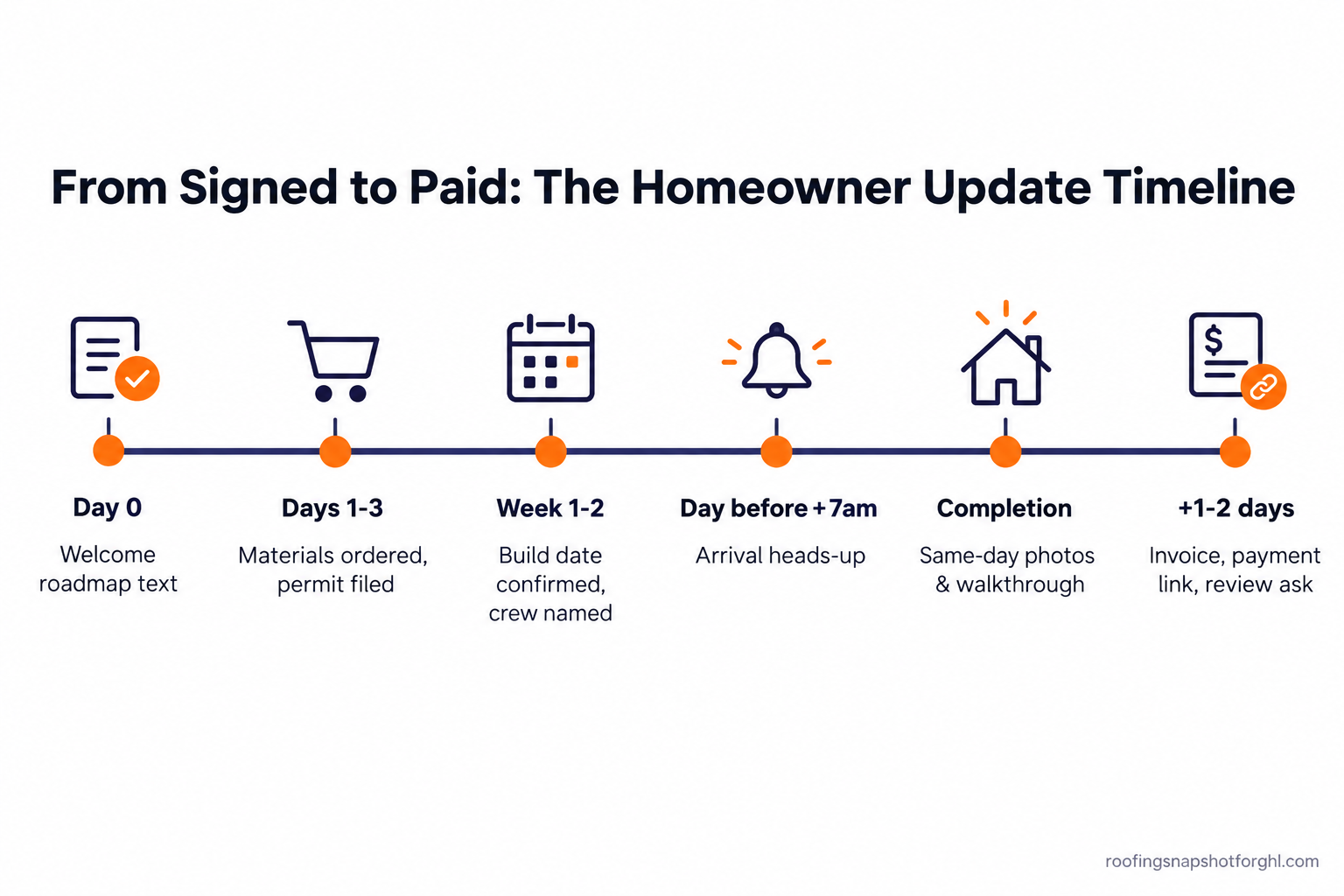
The single most valuable text you send on a roofing job goes out within an hour of the signature, and it is not a thank-you. It is a roadmap. The homeowner’s anxiety starts the second the pen leaves the paper, and the only thing that calms it is knowing what happens next and roughly when.
Setup steps. Build one automated welcome message that fires when a contract is marked signed in your system. It thanks them, names their project manager or point of contact, and lays out the next three steps in plain language: materials get ordered this week, the permit gets filed, and you will text them the build date as soon as it is locked. Give a realistic window, not a promise you cannot keep. Attach a short “what to expect on install day” note if you have one.
How it breaks. The silent signing. You collect the deposit, you are mentally on the next lead, and the homeowner hears nothing for six days. In their head, six days of silence after a big payment is not “they are busy,” it is “something is wrong.” That is the exact gap where Houzz found timeline confusion is the top frustration (Houzz, 2025). One automated text closes it permanently.
Stage 2: Keep them posted while materials and the permit move
This is the dead zone. Nothing visible is happening on the roof, but plenty is happening behind it, and the homeowner cannot see any of it. A shop with no system goes dark here and hopes the customer is patient. A shop with a system sends two or three short “still moving” updates that cost you nothing and buy you a calm customer.
Setup steps. Trigger a brief update when the materials are ordered (“Your shingles and accessories are ordered, we are on track for your window”) and another when the permit clears or the delivery is scheduled. If something slips, and roofing jobs slip, send the update before they ask, not after. A delay you announce is a minor note. A delay they discover is a betrayal.
How it breaks. The unannounced slip. Your supplier is two days late on the shingles, you figure you will just tell them when the crew is scheduled, and in the meantime the homeowner texts “any update?” twice and gets nothing back. Now the real problem is not the two-day delay, it is that you went quiet, and that is what the review will say. Proactive beats reactive every time, and automation is what makes proactive actually happen when you are on a roof all day.
Stage 3: Confirm the build date and who is coming
Once the date is set, this is the text that turns an anxious customer into an excited one. It is also the one that prevents the single most common install-day disaster: a homeowner who had no idea you were coming.
Setup steps. When the job is scheduled, send a confirmation with the date, the rough arrival time, the name of the crew lead or project manager, and a one-line note on what the day looks like (“crew arrives around 7, roof is usually done in a day, you do not need to be home”). Give them a way to reply or reschedule. This is the same confirm-and-remind logic that keeps inspections from no-showing, and we built that whole flow in how to reduce roofing inspection no-shows.
How it breaks. “Scheduled” in your calendar but never in theirs. The job is on your board for Thursday, the crew knows, the supplier knows, and the one person standing in the driveway when six trucks pull up has no clue. Now you are managing a scared, angry homeowner instead of building a roof. A confirmation text the moment the date locks makes that impossible.
Stage 4: The day before and the morning of
Install day is loud, messy, and fast. For you it is routine. For the homeowner it is a dumpster on the lawn, a crew of strangers, nail guns at dawn, and debris everywhere for a few hours. Two short texts turn that from alarming to reassuring.
Setup steps. Send a reminder the day before with the arrival window and a short prep list: move cars out of the driveway, take fragile things off the walls, keep pets inside, and expect noise and debris that gets cleaned up before the crew leaves. Then a quick “crew is on the way, arriving around 7” text the morning of. Both can fire automatically off the scheduled date.
How it breaks. No heads-up, so the homeowner wakes up to a driveway they cannot use and a crew they did not expect. Even a perfect install starts on the wrong foot. The prep list matters too: skip it and you get a cracked heirloom off a vibrating wall or a car boxed in behind the dumpster, and that becomes the story they tell instead of the great roof.
Stage 5: Walk the finished roof with photos
The roof is done, the driveway is magnet-swept, the crew is gone. This is the moment most shops treat as the end. It is actually the most valuable communication touch on the entire job, because it is where you convert a finished roof into proof, a review, and a referral.
Setup steps. When the job is marked complete, send a completion message with before-and-after photos, a note that the site is cleaned and the magnet sweep is done, and a plain summary of what was installed. For insurance jobs, this photo set is also your documentation for the final invoice and any supplement, which ties straight into your insurance claim follow-up system. Photos do double duty: they reassure the homeowner and they protect you if a question comes up later.
How it breaks. The invisible finish. The crew leaves, the homeowner comes home to a clean yard and a roof they cannot really see from the ground, and they are left wondering whether it was done right. No photos, no walkthrough, no summary. The job that should have earned a glowing review earns a shrug, and a shrug does not get posted anywhere.
Stage 6: Collect payment and ask for the review
Final payment and the review request are the same moment, and the timing is everything. A happy homeowner on completion day will pay fast and leave a five-star review. The same homeowner three weeks later, after the glow fades and a small question goes unanswered, pays slow and leaves nothing, or worse.
Setup steps. When the job is complete and the walkthrough is sent, trigger the final invoice with a simple online payment link, then a review request a day or two after payment clears. Make the review ask a one-tap link straight to your Google profile. Ask every completed customer, every time, automatically. The full build-it-once version of this is in how roofers get more Google reviews on autopilot, and the same happy moment feeds your referral program.
How it breaks. Asking late, asking by hand, or not asking at all. Reviews decay, and BrightLocal found 74% of readers want them from the last three months (BrightLocal, 2026). If your review ask is a thing you remember to do sometimes, your profile fills slowly with old reviews while competitors who automate it stack fresh ones. One timed, automatic ask on every finished job fixes that for good.
Run it for a solo, a mid-size, and a large shop
The six stages do not change. Who runs them and how much you automate does.
Solo operator, 1 crew. You are the salesperson, the project manager, and half the crew, which means the communication is the first thing that falls off when you get busy. That is exactly why you automate it first. Every stage fires on its own off the job status, so the welcome text, the materials update, the build confirmation, the day-before reminder, and the review ask all happen whether or not you remembered. For a one-person shop, this system is the difference between looking like a real company and looking like a guy who disappears after the deposit.
Mid-size, 3 to 5 crews. Now the problem is consistency. One project manager texts customers constantly, another never does, and your reviews are a coin flip depending on who ran the job. Standardize it. The same sequence fires for every job regardless of who is managing it, and you can see which jobs got which touches. This is also where tying job status to communication pays off, because the crew marking a roof complete in the field is what triggers the completion photos and the review ask, with no office step in between.
Large shop, 6 or more crews. At volume, communication is a brand, and inconsistency is a liability. Every job runs the identical signed-to-paid sequence, completion photos are logged, and review requests go out on a schedule you can report on, so you can watch review velocity by crew and by market. A multi-county storm that drops dozens of jobs at once is only manageable when the communication is fully automated. Nobody hand-texts 60 homeowners through a build.
Keeping the texts legal
Post-sale texts feel harmless, and most of them are, but a few rules still apply and getting them wrong undoes the whole system.
Service texts and marketing texts are not the same. Confirmations, reminders, and “your crew is on the way” are transactional service messages tied to a job the homeowner hired you for. The review request and any “refer a friend” offer are marketing. Keep an opt-out on everything anyway, honor every STOP instantly and globally, and keep your number registered under A2P 10DLC so the messages actually deliver, which we cover in detail in A2P 10DLC registration for roofing contractors.
Do not gate your reviews. It is tempting to text a happy-sounding customer for a review and quietly skip the grumpy one. The FTC’s Consumer Reviews and Testimonials Rule, effective October 2024, bars suppressing or discouraging honest negative reviews (FTC, 2024). The right move is to ask everyone and to route service complaints to a person who fixes them fast, not to block the review. A problem solved on completion day usually turns into a good review on its own.
Steal this: the signed-to-paid copy
Here is the language, verbatim, for the moments that matter. Swap in your company name and details. Every automated message carries an opt-out.
Notice the rhythm. The homeowner never goes more than a few days without hearing from you, every message tells them something real, and the review ask lands when they are happiest. None of it requires you to remember anything once it is built.
Objections
“Won’t all these texts annoy people?” Not if each one carries real information. The annoying version is five “just checking in” messages that say nothing. This system sends updates people actually want: when materials are ordered, when the date is set, when the crew is coming, when it is done. Houzz found communication is the top thing homeowners struggle to get, not the thing they are drowning in (Houzz, 2025). You are solving a shortage, not adding noise.
“I already use AccuLynx or JobNimbus for my jobs.” Keep it. The gap most roofing CRMs leave is the automatic, timed, customer-facing messaging that fires off job status without anyone clicking send. Run the communication sequence alongside your production software, triggered by the same job stages you already track. We compared what the main platforms actually cost and cover in what roofing software actually costs in 2026.
“My customers are older and do not text.” Most do, and the ones who do not can get the same sequence by automated call or email. The point is not the channel, it is that the update goes out on its own at the right moment. For a customer who prefers a phone call, the system flags you to call instead of letting the moment pass.
“I do not have time to set all this up.” You set it up once, and after that it runs on every job forever. The hours you spend building it come back the first week in texts you do not have to send by hand and angry calls you never get. If you would rather not build it, this is exactly the kind of done-for-you setup our dedicated GoHighLevel VA or a prebuilt install handles.
Related reading
- How roofers get more Google reviews on autopilot
- Roofing referral program: how to build one that actually sends you storm jobs
- How to reduce roofing inspection no-shows
- The insurance claim follow-up system
- A2P 10DLC registration for roofing contractors
Close
Back to that Tuesday signing. This time the handshake was not the last the homeowner heard from you. Within the hour they got the roadmap. They got a note when the shingles were ordered, their install date with the crew lead’s name, a reminder to move the cars the night before, a photo set the afternoon the roof was finished, and a one-tap review link two days after they paid. They did not text you once wondering if something was wrong, because nothing ever felt wrong. They left a five-star review that week, and they already told two neighbors.
The roof was always going to be good. The difference is that this time the customer knew it the whole way through. Build the signed-to-paid sequence once, let it run on every job, and the silence that quietly costs you reviews and referrals is gone for good.
Frequently asked questions about roofing customer communication
How often should I update a roofing customer after they sign?
At every real milestone, not on a timer. That means a welcome message within an hour of signing, an update when materials are ordered, the confirmed build date, a day-before and morning-of reminder, a completion message with photos, and a review ask after payment. Houzz found timeline and communication are the top in-project frustrations for homeowners, so the goal is that they never go more than a few days wondering what is happening (Houzz, 2025).
What should the first text after signing say?
Not just thank you. It should lay out the next steps and a realistic timeline: materials are being ordered, the permit is being filed, and you will send the exact install date within a set window. This sets the clock yourself so the homeowner does not invent a faster one in their head, which is where most timeline complaints start.
When is the best time to ask for a Google review?
A day or two after the job is complete and paid, while the customer is happiest. Reviews decay fast: BrightLocal found 74% of people want reviews from the last three months and 32% want them from the last two weeks (BrightLocal, 2026). Asking automatically on every finished job keeps a steady stream of fresh reviews instead of a few old ones.
Is it legal to only ask happy customers for reviews?
No. The FTC's Consumer Reviews and Testimonials Rule, effective October 2024, prohibits suppressing or discouraging honest negative reviews (FTC, 2024). Ask every completed customer. If someone is unhappy, route them to a person who fixes the problem quickly rather than blocking their review.
Do post-sale service texts need the same consent as marketing texts?
Transactional service texts tied to a job the customer hired you for, like a build-date confirmation or an arrival reminder, are treated differently from marketing texts like a review or referral ask. Keep an opt-out on everything, honor STOP instantly, and keep your number registered under A2P 10DLC so the messages deliver at all (A2P 10DLC for roofers).
Can I automate all of this without hiring someone full time?
Yes. The whole sequence fires off job status changes you already track, so once it is built it runs on every job with no one clicking send. A solo operator can run the same professional communication as a large shop. The setup is a one-time job, and a prebuilt roofing automation install handles it in about a day.